
The Hidden Layer in OpenClaw Swarms: Make Them Disagree, See Who Survives
Why parallel AI agents still collapse into groupthink, and how an adversarial review layer forces useful disagreement before the final merge.

Written by
Vox
Listen to the recovered audio edition of this piece.
The most dangerous output an AI swarm can give you is a perfect, unanimous answer. This is the story of how I broke that, and a ready-to-use template at the end.
A classic indie developer dilemma: $5,000 budget, 3 months, 200 free users, 0 paying users. What's the next move?
I threw this question at my AI swarm. The coordinator read the prompt, decided it needed 4 specialist perspectives, and hired them: one for conversion analysis, one to evaluate whether to pivot, one for decision scoring, and one to audit the data reliability.
All 4 specialists worked simultaneously, blind to each other. 1 minute 52 seconds later, 4 reports came back.
Result: unanimous Option A. Start charging now.
The conversion analyst delivered a full pricing plan: $30-100/month, 2-4 weeks to ship a paywall, target the 20 most active users as seed customers. The decision scorer ranked the four options: A scored 4.40, far ahead, nothing else broke 3. The pivot evaluator said A first, then C. The data auditor said install analytics first, but still A.
Decision matrices, conversion projections, 6-week checkpoints, action plans precise down to the week. Looked bulletproof.
But when I finished reading, one thing stuck: 4 specialists, 4 analytical angles, 4 reports with different emphases. And not a single one said "I disagree."
Unanimous approval. Zero dissent.
In the real world, this is called groupthink.
Parallel Doesn't Mean Multi-Perspective
Most AI swarms work like this: generate a batch of specialists, each analyzes independently, merge the reports at the end. Like locking 4 people in 4 separate rooms to each write a report, then binding them into one handbook.
Fast, yes. But nobody read what anyone else wrote. The conversion analyst didn't know the data auditor wrote "we currently have no user engagement data." So he built a precise forecast on industry averages, on an empty foundation.
Having 4 people write separate reports and binding them together is not the same as having 4 people sit down for a meeting. The binder can be thick, but if nobody slammed the table, thickness isn't depth.
Looking Back: What Questions Should Have Been Asked
Imagine you're an investor. The founder slaps these 4 reports in front of you. You'd probably ask two questions within 30 seconds.
First: "Of these 200 users, how many are actually still using the product?"
All 4 reports were built on one assumption: 200 registered users = 200 potential paying customers. But the data auditor wrote in his own report: "we currently have no user engagement data." The other 3 specialists couldn't see that line. They each sat in their room and ran precise calculations based on "industry average 3% conversion rate": 200 × 3% = 6 paying users × $50 = $300/month.
What if only 15 of those 200 are still logging in? 3% of 15 is zero. A precise calculation built on sand is more dangerous than a rough guess. Because it looks like it has evidence.
Second: "Not a single report mentions competitors?"
If the category already has free alternatives, adding a paywall won't bring 6 paying customers. It'll make 200 free users leave.
These aren't hard questions. Any experienced founder sitting across from you would ask them all within 5 minutes. But 4 AI specialists didn't ask. Not because they weren't smart enough, but because the system had no "questioning" step. They were designed to answer questions, not to challenge answers.
The Hidden Layer
The fix isn't complicated.
The old flow was two steps: specialists write reports → coordinator merges them. What's missing is the middle step: someone reads the reports and says "hold on, this doesn't add up."
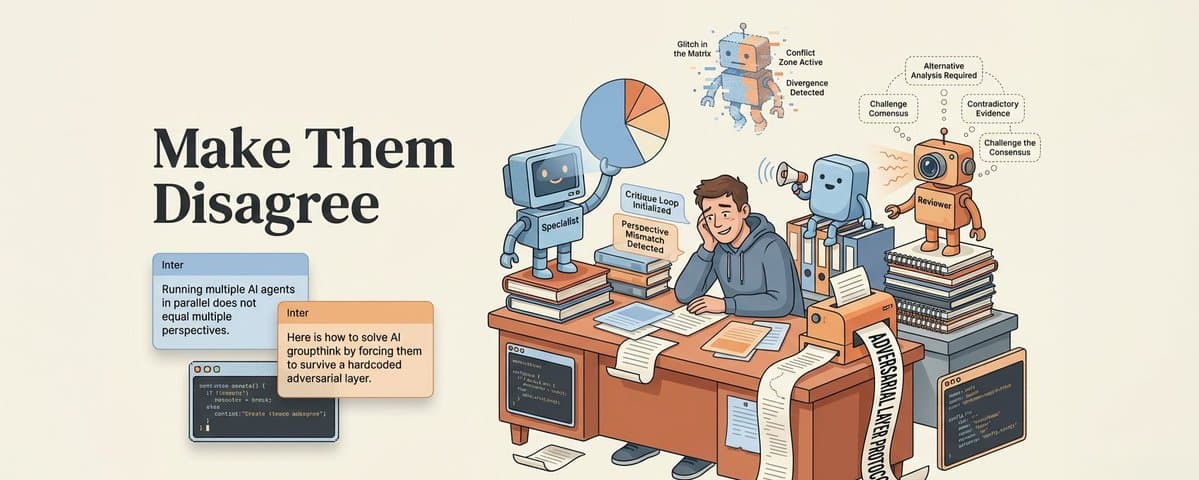
I added that step. I call it the "adversarial round." The entire flow becomes three phases:
Phase 1: Independent analysis. Same as before. The coordinator hires a batch of specialists, each writes independently, blind to each other. This preserves the benefit: everyone has their own thinking, nobody gets pulled by someone else's framing.
Phase 2: Cross-examination. This is new. After all reports come back, the coordinator doesn't rush to merge. Instead, it hires a few "reviewers." Each reviewer gets 2-3 specialist reports. Their only job: find problems.
Here's the key design: the reviewer's task is hardcoded. Not "take a look and see if anything's off," but an output contract. Every reviewer must deliver:
[OUTPUT_CONTRACT]
1) TOP 3 OPPOSING ARGUMENTS
2) OVERESTIMATED FACTORS (2 items)
3) UNDERESTIMATED FACTOR (1 item)
4) CONTRADICTIONS — direct conflicts between specialist outputs
5) REMAINING BLIND SPOTS
6) Overall Review Confidence (0-5)
7) DECISION SIGNAL — one of: proceed | proceed_with_caution | block
8 ) MACHINE_READABLE_JSON:
{"decision":"proceed|proceed_with_caution|block",
 "confidence":0,
 "oppositions":[""],
 "overestimated":[""],
 "underestimated":[""],
 "contradictions":[""],
 "blind_spots":[""],
 "blockers":[""]}
Notice the JSON at the end. The reviewer doesn't just write a text opinion. It also outputs structured data that the system can parse directly. proceed, proceed_with_caution, block. Three signals, no ambiguity.
Why hardcode it? Because if you just say "please review this," AI will politely agree and add a few harmless suggestions. Same as not reviewing at all.
Forcing "you must find 3 problems" makes the reviewer actually dig. Even if the original report is genuinely good, the reviewer has to find something to challenge. This isn't about being contrarian. It's about making sure every conclusion has been seriously checked at least once.
Another key point: reviewers and original specialists are completely isolated. The reviewer never saw how the specialist reasoned step by step. They only see the final conclusions. So their challenges come from an outsider's perspective: "you're telling me the conclusion is A, but I think you missed X." That's far more useful than "a colleague checking for typos."
And reviewers aren't randomly assigned. The adversarial round only activates when there are 3 or more specialists (too few and cross-examination doesn't make sense). Once activated, the system uses rotation to assign review tasks:
const reviewerCount = Math.max(1, Math.ceil(n / 2));
for (let i = 0; i < reviewerCount; i++) {
  const indices = [...new Set([
    ((i * 2) % n),
    (((i * 2) + 1) % n),
    (((i * 2) + 2) % n)
  ])];
  // each reviewer gets 2-3 specialist reports
}

// when specialists >= 4, auto-add a "global skeptic"
if (n >= 4) {
  jobs.push({
    role: 'global_skeptic',
    reviewedSpecialists: all  // reads every report
  });
}
With 3 specialists, rotation alone achieves dual coverage (every report seen by 2 reviewers). With 4 or more, the system also adds a "global skeptic" on top of the regular reviewers. It doesn't just read 2-3 reports. It reads all of them. Its job is to find things that look reasonable locally but contradict each other when combined.
Phase 3: Judgment. The coordinator now has two stacks: the original specialist reports, and the reviewer challenges. Its job is no longer to simply merge. It's to be the judge.
For each core conclusion, the coordinator makes a ruling:
Retain - reviewers challenged it, but the conclusion held up
Needs more evidence - the challenge has merit, needs more data to confirm
Overturn - the challenge directly undermines the conclusion's foundation
In the final output, readers don't just see answers. They see how the answers were tested. Which conclusions survived, and which didn't.
Before vs After
Same question. Same swarm. The only difference: with or without the adversarial round.
Before (no adversarial round):
4 specialists, 1 minute 52 seconds, unanimous Option A: start charging now.
The conversion analyst delivered a full pricing plan. The decision scorer gave A a 4.40, everything else below 3. The pivot evaluator said A first then C. The data auditor said install analytics but still A. Action plan precise to the week: ship paywall by Week 2, check results at Week 6.
Confidence? Nobody said explicitly, but 4 people all picking the same answer implies "this isn't even debatable."
Reads well.
After (with adversarial round):
Same question, 4 specialists + 3 reviewers (including a global skeptic) + 1 synthesizer, 3 minutes 51 seconds, 8/8 completed.
The reviewers immediately uncovered blind spots the specialists collectively missed.
Reviewer 1 cut straight to the core: "All specialists assumed 200 users are active users, but the prompt only says '200 free users, 0 paid' with zero engagement data. If most of those 200 signed up and never came back, every conversion benchmark is built on a false foundation."
Reviewer 2 followed up: "0 paid might not be a conversion failure at all. It might mean no paywall has ever been attempted. If the founder never asked anyone to pay, 0/200 isn't a negative signal. It's a null experiment."
The global skeptic was the sharpest. After reading all specialist reports, it pointed to one specialist's claim that "0 paid almost always means no paywall was attempted," rated at 4/5 confidence. The global skeptic's assessment, in one line: "optimism bias dressed as data."
All three reviewers' verdicts: proceed_with_caution. Not a single proceed.
The synthesizer received the specialist reports and reviewer challenges, then made its ruling:
Option A downgraded from "strongly recommended" to "conditionally recommended"
Added a step the specialists never had: Week 1, answer three gating questions first - has a paywall ever existed? What's D7/D30 retention? Where did the 200 users come from?
Option C upgraded from "don't consider" to "switch immediately if Week 3 data doesn't meet threshold"
Added a hard exit condition: Week 8, if zero paying customers and no viable niche identified, abandon the project and preserve remaining capital
Final confidence: 3/5. Not 4, not 5. The synthesizer explicitly acknowledged this plan might be wrong.
The final output was no longer a single answer, but a decision tree: A→C→D, each step with explicit entry and exit conditions.
Were the final recommendations roughly the same? Yes. Both said A.
But the difference: the After plan knows it might be wrong, and has already planned what to do if it is. The Before plan doesn't know it could be wrong.
And this isn't just a change at the "advice" level. In the code, reviewer verdicts feed directly into the state machine:
// aggregate all reviewer signals
meta.review_gate = {
  reviewers_total: phase2Signals.total,
  reviewers_parsed: phase2Signals.parsed,
  blocked: phase2Signals.blocked,
  caution: phase2Signals.caution,
  blockers: phase2Signals.blockers
};

// when synthesizer doesn't give a clear verdict,
// system falls back based on reviewer signals
synthesisDecision = parsedDecision
  ?? (reviewerBlocked > 0 ? 'HOLD' : 'GO');

// HOLD = task fails, doesn't slip through
const finalStatus = synthesisDecision === 'HOLD'
  ? 'failed'
  : 'succeeded';
Simple logic: if reviewers flagged block and the synthesizer didn't produce a clear "GO," the system automatically falls back to HOLD and the entire task is marked failed. Not "here's a warning, proceed at your own risk." It actually doesn't pass.
That's the difference between an adversarial layer and a rubber-stamp review: it has teeth.
A confident answer that was never tested, and a confident answer that survived challenges - completely different value.
Here's the real data comparison:
Before (no adversarial layer): 4 specialists. 1m 52s. Unanimous Option A. Implied confidence 4-5/5. Zero blind spots identified. No exit conditions. Single option.
After (with adversarial layer): 4 specialists + 3 reviewers + 1 synthesis. 3m 51s. Option A, with preconditions. Explicit confidence 3/5. 6+ critical blind spots identified. Week 8 hard kill date. A→C→D sequential decision tree.
Two extra minutes. In return: an answer that knows where its own boundaries are.
From Personality to System
I actually tried making agents "argue" with each other much earlier. The method was crude: I wrote in one agent's personality description, "you often disagree with Xalt's views."
It worked, somewhat. That agent would occasionally push back in daily conversations, and discussion quality improved. But this was "personality friction," relying on the "relationship" between two agents that work together long-term. Temporarily hired specialists have no personality, no history, and exist for less than 2 minutes. You can't cultivate a critical spirit in someone who only lives for 2 minutes.
The adversarial round does something different. It doesn't depend on "who this agent is." It depends on "whether the process includes a questioning step." Regardless of which specialists, regardless of which reviewers, as long as the process has this step, output quality improves.
It's like why code review exists. Not because you don't trust the person who wrote the code. It's because a second pair of eyes sees things the first pair can't. Even if the coder is the strongest engineer on the team, review still has value.
AI swarms are the same. Every specialist might be excellent. But a conclusion that was never challenged - you don't know if it's actually right, or if nobody just checked.
Take It and Use It
Regardless of what tools you use, the template below works out of the box.
Three-Phase Coordinator Prompt
You are a decision coordinator. Complete the analysis in three phases:
Phase 1: Independent Analysis
- Based on what the question needs, generate 4-6 specialists from different domains
- Each specialist analyzes independently, blind to each other's work
- Each specialist must output: · Core conclusion + confidence score (0-5) · 3 strongest supporting arguments · 2 biggest risks or unverified assumptions · 1 "this conclusion looks right but might have a problem" warning
Phase 2: Cross-Examination
- After collecting all reports, generate 2-3 reviewers
- Each reviewer receives 2-3 specialist reports
- Each reviewer must output: · 3 opposing arguments (must be specific, cannot say "overall looks good") · 2 overestimated points (everyone thinks it's important, but it might not be) · 1 underestimated point (everyone missed it, but it might be critical) · 1 "nobody mentioned this at all" blind spot
Phase 3: Judgment
- Synthesize specialist reports + reviewer challenges
- For each core conclusion, rule: retain / needs more evidence / overturn
- Mark which conclusions survived challenge and which didn't
- Give final recommendation with confidence level and remaining risks
How to Configure
Simple questions (choosing between a few options): 4 specialists + 2 reviewers.
Complex questions (open-ended research, like industry analysis or product strategy): 6 specialists + 3 reviewers.
Reviewers don't need to be one-to-one with specialists. 3 reviewers covering 6 reports, each reading 2, with every report seen by at least 1 reviewer, is enough.
The most important point: the reviewer output format must be hardcoded. "3 opposing arguments" is not a suggestion, it's a hard requirement. Without this constraint, reviewers will politely say "the analysis is comprehensive, I mostly agree," and the reviewer you're paying for becomes a rubber stamp.
Works Without an AI Swarm Too
No multi-agent system? No problem. As long as you have a single AI chat window, you can run these three steps manually:
Tell the AI "you are a market expert," have it analyze the problem, save the conclusion
Open a new conversation, tell the AI "you are a finance expert," have it analyze the same problem
Open another new conversation, paste both experts' conclusions, tell the AI "you are a reviewer, your job is to find contradictions, blind spots, and unverified assumptions in these two reports"
It won't be as good as truly independent multi-agent runs - the same model arguing with itself won't escape its own cognitive blind spots just because you changed the role. But it's far better than asking once and walking away with a single answer.
Adversarial thinking isn't the goal. Verification is. The tool doesn't matter. What matters is whether, before you make a decision, someone (or some step) tried to overturn your conclusion.
Consensus Is Not the Goal
AI teams and human teams share the same trap: the most dangerous moment isn't when people start arguing. It's when everyone nods.
Arguments mean disagreement. Disagreement means you know there's risk, you can investigate, verify. Unanimous approval is what's scary: "4 experts all agreed, so it must be fine." Then you execute, and fall into a pit nobody saw.
Good decisions are never "passed." Good decisions are "someone tried to overturn them, and they still stood."
The next step for AI swarms isn't adding more specialists. More specialists just means more reports, a thicker binder, a stronger false sense of security.
The next step is adding a round of challenge to your process. Let conclusions be seriously challenged before they're adopted.
We build AI systems in our own image. Teams that reward agreement build agents that agree. Teams that reward speed build agents that skip verification. The architecture reflects the builder.
If your agents always say yes to each other, the question isn't about your agents. It's about what you optimized for.
The hardest part of adding an adversarial layer isn't the code. It's accepting that your first answer was probably incomplete.
This adversarial layer is one piece of a larger system. If you want to see how the full swarm works, coordinators hiring specialists, reviewers cross-examining reports, synthesizers making final rulings, I wrote about the architecture in an earlier article: I Built an AI Company with OpenClaw. Now It's Hiring.
You can also watch a live swarm run at voxyz.space/swarm. If you want the complete orchestration kit, database, worker, coordinator, dashboard, it's in Ship Faster Pro.
The answers that survive are the ones worth trusting.
Next step
If you want to build your own system from this article, choose the next step that matches what you need right now.